Monday, March 9, 2020

Freelance


Freelance (sometimes spelled free-lance or free lance), freelancer, and freelance worker, are terms commonly used for a person who is self-employed and is not necessarily committed to a particular employer long-term. Freelance workers are sometimes represented by a company or a temporary agency that resells freelance labor to clients; others work independently or use professional associations or websites to get work.
While the term independent contractor would be used in a different register of English to designate the tax and employment classes of this type of worker, the term "freelancing" is most common in culture and creative industries, and use of this term may indicate participation therein.
Fields, professions, and industries where freelancing is predominant include: music, writing, acting, computer programming, web design, graphic design, translating and illustrating, film and video production and other forms of piece work which some cultural theorists consider as central to the cognitive-cultural economy.

Moving company


A moving company, removalist or van line is a company that helps people and businesses move their goods from one place to another. It offers all-inclusive services for relocations like packing, loading, moving, unloading, unpacking, arranging of items to be shifted. Additional services may include cleaning services for houses, offices or warehousing facilities.

Video game publisher


A video game publisher is a company that publishes video games that have been developed either internally by the publisher or externally by a video game developer.
They often finance the development, sometimes by paying a video game developer (the publisher calls this external development) and sometimes by paying an internal staff of developers called a studio. The large video game publishers also distribute the games they publish, while some smaller publishers instead hire distribution companies (or larger video game publishers) to distribute the games they publish. Other functions usually performed by the publisher include deciding on and paying for any licenses used by the game; paying for localization; layout, printing, and possibly the writing of the user manual; and the creation of graphic design elements such as the box design. Some large publishers with vertical structure also own publishing subsidiaries (labels).
Large publishers may also attempt to boost efficiency across all internal and external development teams by providing services such as sound design and code packages for commonly needed functionality.
Because the publisher often finances development, it usually tries to manage development risk with a staff of producers or project managers to monitor the progress of the developer, critique ongoing development, and assist as necessary. Most video games created by an external video game developer are paid for with periodic advances on royalties. These advances are paid when the developer reaches certain stages of development, called milestones.

Minecraft


Minecraft is a sandbox video game created by Swedish developer Markus Persson, released by Mojang in 2011 and purchased byMicrosoft in 2014. It is the single best-selling video game of all time, selling over 180 million copies across all platforms by late 2019, with over 112 million monthly active players.
In Minecraft, players explore an intentionally blocky, pixelated, procedurally-generated 3D world, and may discover and extract raw materials, craft tools, build structures or earthworks, and, depending on game mode, can fight computer-controlled foes, as well as either cooperate with or compete against other players in the same world. These modes include a survival mode, in which players must acquire resources to build the world and maintain health, and a creative mode, where players have unlimited resources. In theJava Edition, players can modify the game with mods to create new gameplay mechanics, items, textures and assets.
Minecraft has been critically acclaimed, winning numerous awards, and has been described as one of the most influential and greatest video games of all time. Social media, parodies, adaptations, merchandise, and the annual MineCon conventions played large roles in popularizing the game. It has also been used in educational environments, especially in the realm of computing systems, as virtual computers and hardware devices have been built in it. A number of spin-off games have also been developed, such as Minecraft: Story Mode, Minecraft Earth, and Minecraft Dungeons.

Counter Strike : Global Offensive


Counter-Strike: Global Offensive is a multiplayer first-person shooter video game developed by Valve and Hidden Path Entertainment. It is the fourth game in the Counter-Strike series and was released for Windows, OS X, Xbox 360, and PlayStation 3 in August 2012, while the Linux version was released in 2014.
The game pits two teams against each other: the Terrorists and the Counter-Terrorists. Both sides are tasked with eliminating the other while also completing separate objectives. The Terrorists, depending on the game mode, must either plant the bomb or defend the hostages, while the Counter-Terrorists must either prevent the bomb from being planted, defuse the bomb, or rescue the hostages. There are nine game modes, all of which have distinct characteristics specific to that mode. The game also has matchmaking support that allows players to play on dedicated Valve servers, as well as allowing members of the community to host their own servers with custom maps and game modes. A battle-royale game-mode, "Danger Zone", was introduced in 2018.
Global Offensive received positive reviews from critics on release, who praised for its gameplay and faithfulness to predecessors, though it was criticized for some of its early features and was noted for differences between the console and PC versions. Since its release, it has drawn in an estimated 11 million players per month, and has gathered an active competitive scene, with many tournaments sponsored by Valve themselves. In December 2018, Valve transitioned the game to a free-to-play model, focusing on 

The Idolm@ster


The Idolmaster (アイドルマスター, Aidorumasutā, officially stylized as THE iDOLM@STER) is a Japanese raising simulation video game developed by Metro and published by Namco (later Namco Bandai Games). It was released on July 26, 2005 as an arcade game and is the first game in The Idolmaster series. It was ported to the Xbox 360 on January 25, 2007 with many changes and improvements. The gameplay and story follows the career of a producer in charge of training prospective pop idols on their way to stardom. This includes arranging the idol's schedule, taking them to jobs, training them during lessons, and directing them through auditions. As gameplay continues, a relationship will develop between the idol and her producer fostered through talking with the idol and forming good memories.
Development for the game began in 2001 to make an arcade game that would make players want to come back to play every day. To effectively use the competitive culture that surrounds video arcades, the game was developed so players would raise and compete against other players' idols on a national network. A port of the game had been discussed as early as two months before the arcade game was even released. The Xbox 360 was chosen because the development team felt its hardware and the Xbox Live network could handle the game's specifications. The original game features 10 songs the idols perform, which is increased to 16 in the Xbox 360 version, later released on several music albums. The raising simulation system has been described as simple and easy to understand, and the various minigames have been described as "addictive". However, the game has been criticized as presenting a narrow and unrealistic view of the idol world.

Hide-and-seek


Hide-and-seek, or hide-and-go-seek, is a popular children's game in which any number of players (ideally at least three) conceal themselves in a set environment, to be found by one or more seekers. The game is played by one player chosen (designated as being "it") closing their eyes and counting to a predetermined number while the other players hide. After reaching this number, the player who is "it" calls "Ready or not, here I come!" or "Coming, ready or not!" and then attempts to locate all concealed players.
The game can end in one of several ways. the most common way of ending is the player chosen as "it" locates all players; the player found last is the winner and is chosen to be "it" in the next game. Another common variation has the seeker counting at "home base"; the hiders can either remain hidden or they can come out of hiding to race to home base; once they touch it, they are "safe" and cannot be tagged. In Ohio, a hider must yell "free" when he touches base or he can still be tagged out. But if the seeker tags another player before reaching home base, that person becomes "it", or "the seeker".

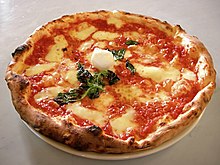
Pizza


Pizza (Italian: [ˈpittsa], Neapolitan: [ˈpittsə]) is a savory dish of Italian origin, consisting of a usually round, flattened base of leavenedwheat-based dough topped with tomatoes, cheese, and often various other ingredients (anchovies, olives, meat, etc.) baked at a high temperature, traditionally in a wood-fired oven. A small pizza is sometimes called a pizzetta.
In Italy, pizza served in formal settings, such as at a restaurant, is presented unsliced and eaten with the use of a knife and fork. In casual settings it is cut into wedges to be eaten while held in the hand.
The term pizza was first recorded in the 10th century in a Latin manuscript from the Southern Italian town of Gaeta in Lazio, on the border with Campania. Modern pizza was invented in Naples, and the dish and its variants have since become popular in many countries. It has become one of the most popular foods in the world and a common fast food item in Europe and North America, available at pizzerias (restaurants specializing in pizza), restaurants offering Mediterranean cuisine, and via pizza delivery. Many companies sell ready-baked frozen pizzas to be reheated in an ordinary home oven.
The Associazione Verace Pizza Napoletana (lit. True Neapolitan Pizza Association) is a non-profit organization founded in 1984 with headquarters in Naples that aims to promote traditional Neapolitan pizza.In 2009, upon Italy's request, Neapolitan pizza was registered with the European Union as a Traditional Speciality Guaranteed dish, and in 2017 the art of its making was included on UNESCO's list of intangible cultural heritage.

Bali


Bali is a province of Indonesia and the westernmost of the Lesser Sunda Islands. Located east of Java and west of Lombok, the province includes the island of Bali and a few smaller neighbouring islands, notably Nusa Penida, Nusa Lembongan, and Nusa Ceningan. The provincial capital, Denpasar, is the most populous city in the Lesser Sunda Islands and the second largest, after Makassar, in Eastern Indonesia. Bali is the only Hindu-majority province in Indonesia, with 83.5% of the population adhering to Balinese Hinduism.
Bali is Indonesia's main tourist destination, with a significant rise in tourism since the 1980s. Tourism-related business makes up 80% of its economy. It is renowned for its highly developed arts, including traditional and modern dance, sculpture, painting, leather, metalworking, and music. The Indonesian International Film Festival is held every year in Bali. Other international events held in Bali include the Miss World 2013 and 2018 Annual Meetings of the International Monetary Fund and the World Bank Group. In March 2017, TripAdvisor named Bali as the world's top destination in its Traveller's Choice award.
Bali is part of the Coral Triangle, the area with the highest biodiversity of marine species especially fish and turtles. In this area alone, over 500 reef-building coral species can be found. For comparison, this is about seven times as many as in the entire Caribbean. Bali is the home of the Subak irrigation system, a UNESCO World Heritage Site. It is also home to a unified confederation of kingdoms composed of 10 traditional royal Balinese houses, each house ruling a specific geographic area. The confederation is the successor of the Bali Kingdom. The royal houses are not recognised by the government of Indonesia; however, they originated before Dutch colonisation.

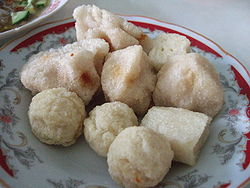
Pempek


Pempek, mpek-mpek or empek-empek is a savoury Indonesian fishcake delicacy, made of fish and tapioca, from Palembang, South Sumatera, Indonesia. Pempek is served with rich sweet and sour sauce called kuah cuka or kuah cuko (lit. vinegar sauce), or just "cuko". Sometimes local people also eat the dish with yellow noodles and diced up cucumber to balance out the vinegar's sourness.

Dendeng


Dendeng refers to thinly sliced dried meat in Indonesian cuisine. It is preserved through a mixture of sugar and spices and dried via a frying process. It is similar to jerky. The creation of dendeng is commonly credited to the Minangkabau people, and their earliest dendeng was made from beef, dried so it would be preserved for days and could be taken along with them when they traveled.
The Padang cuisine version — probably the most popular dendeng dish in Indonesia — is called Dendeng Balado or Dendeng Batokok, and is a speciality from Padang, West Sumatra, made from beef which is thinly cut then dried and fried before adding chillies and other ingredients.
Monday, March 2, 2020

Sendai


Sendai


Sendai (仙台市, Sendai-shi, Japanese: [se'ndai]) is the capital city of Miyagi Prefecture, Japan, the largest city in the Tōhoku region, and the second largest city north of Tokyo. As of 1 June 2019, the city had a population of 1,089,372, and is one of Japan's 20 designated cities. The city was founded in 1600 by the daimyō Date Masamune. It is nicknamed the City of Trees (杜の都, Mori no Miyako); there are zelkova trees lining many of the main thoroughfares such as Jōzenji Street (定禅寺通, Jōzenji dōri) and Aoba Street (青葉通, Aoba dōri).

Modern era

The first railway line between Sendai and Tokyo, now the Tōhoku Main Line, opened in 1887, bringing the area within a day's travel from Tokyo for the first time in history. Tohoku Imperial University, the region's first university, was founded in Sendai in 1907 and became the first Japanese university to admit female students in 1913.
Sendai was incorporated as a city on 1 April 1889, with the post-Meiji restoration creation of the modern municipalities system following the abolition of the han system. At the time of incorporation the city's area was 17.45 square kilometres (6.74 sq mi) and its population was 86,000. The city grew, however, through seven annexations that occurred between 1928 and 1988. The city became a designated city on 1 April 1989; the city's population exceeded one million in 1999.
Sendai was considered to be one of Japan's greenest cities, mostly because of its great numbers of trees and plants. Sendai became known as The City of Trees before the Meiji Restoration, after the feudal Sendai Domain encouraged residents to plant trees in their gardens. As a result, many houses, temples, and shrines in central Sendai had household forests (屋敷林, yashikirin), which were used as resources for wood and other everyday materials.
In 1925, the Senseki Line to Sendai Station became the first underground railway segment in Japan, preceding the opening of the Tokyo Metro Ginza Line (Asia's first subway line) by two years.
The 2nd Infantry Division was known as the "Sendai Division" as it was based in Sendai, and recruited locally. During the Second World War it was involved in many different campaigns, but one of the most important was the Battle of Guadalcanal. During the bombing of Sendai during World War IIby the United States on 10 July 1945, much of the historic center of the city was burned, with 2,755 inhabitants killed and 11,933 houses destroyed in the city.
Following World War II, the city was rebuilt, and Sendai became a vital transportation and logistics hub for the Tōhoku region with the construction of major arteries such as the Tōhoku Expressway and Tōhoku Shinkansen.
Sendai has been subject to several major earthquakes in recent history, including the 1978 Miyagi earthquake, which was a catalyst for the development of Japan's current earthquake resistance standards, and the 2005 Miyagi earthquake. Most recently, the coastal area of Sendai, including Sendai Airport, was severely damaged in the 2011 Tōhoku earthquake and tsunami. The tsunami reportedly reached as far as Wakabayashi Ward Office, 8 kilometers (5.0 mi) from the coastline. Thousands were killed, and countless more were injured and/or made homeless. Sendai's port was heavily damaged and temporarily closed, reopening on 16 April 2011.

Okinawa


Official logo of Okinawa Prefecture

Okinawa Prefecture


CountryJapan
RegionKyushu
IslandOkinawa, Daitō and Sakishima
CapitalNaha
SubdivisionsDistricts: 5, Municipalities: 41
Government
 • GovernorDenny Tamaki
Area
 • Total2,280.98 km2 (880.69 sq mi)
Area rank44th
Population
 (June 1, 2019)
 • Total1,451,965
 • Rank27th
 • Density640/km2 (1,600/sq mi)
ISO 3166 codeJP-47
Websitewww.pref.okinawa.lg.jp
Symbols
BirdOkinawa woodpecker(Sapheopipo noguchii)
FishBanana fish (Pterocaesio diagramma, "takasago", "gurukun")
FlowerDeego (Erythrina variegata)
TreePinus luchuensis("ryūkyūmatsu")
Okinawa Prefecture (Japanese: 沖縄県, Hepburn: Okinawa-ken, Okinawan: ウチナー Uchinaa,Kunigami: フチナー Fuchinaa) is the southernmost prefecture of Japan. It encompasses two thirds of the Ryukyu Islands in a chain over 1,000 kilometres (620 mi) long. The Ryukyu Islands extend southwest from Kagoshima Prefecture on Kyushu (the southwesternmost of Japan's four main islands) to Taiwan. Naha, Okinawa's capital, is located in the southern part of Okinawa Island.


Although Okinawa Prefecture comprises just 0.6 percent of Japan's total land mass, about 75 percent of all United States military personnel stationed in Japan are assigned to installations in the prefecture. Currently about 26,000 U.S. troops are based in the prefecture.
The indigenous people of Okinawa Prefecture are the Ryukyuan people, comprising the Okinawan, Miyako, Yaeyama and Yonaguni subgroups. The Amami people, who are another Ryukyuan subgroup, live in the Amami Islands of Kagoshima Prefecture.

Business


Commercial law


Offices in the Los AngelesDowntown Financial District
A very detailed and well-established body of rules that evolved over a very long period of time applies to commercial transactions. The need to regulate trade and commerce and resolve business disputes helped shape the creation of law and courts. The Code of Hammurabi dates back to about 1772 BC for example and contains provisions that relate, among other matters, to shipping costs and dealings between merchants and brokers. The word "corporation" derives from the Latin corpus, meaning body, and the Maurya Empire in Iron-Age India accorded legal rights to business entities.
In many countries, it is difficult to compile all the laws that can affect a business into a single reference source. Laws can govern the treatment of labour and employee relations, worker protection and safety, discrimination on the basis of age, gender, disability, race, and in some jurisdictions, sexual orientation, and the minimum wage, as well as unions, worker compensation, and working hours and leave.
Some specialized businesses may also require licenses, either due to laws governing entry into certain trades, occupations or professions, that require special education or to raise revenue for local governments. Professions that require special licenses include law, medicine, piloting aircraft, selling liquor, radio broadcasting, selling investment securities, selling used cars, and roofing. Local jurisdictions may also require special licenses and taxes just to operate a business.
Some businesses are subject to ongoing special regulation, for example, public utilities, investment securities, banking, insurance, broadcasting, aviation, and health care providers. Environmental regulations are also very complex and can affect many businesses.

Intellectual property

Businesses often have important "intellectual property" that needs protection from competitors for the company to stay profitable. This could require patents, copyrights, trademarks, or preservation of trade secrets. Most businesses have names, logos, and similar branding techniques that could benefit from trademarking. Patents and copyrights in the United States are largely governed by federal law, while trade secrets and trademarking are mostly a matter of state law. Because of the nature of intellectual property, a business needs protection in every jurisdiction in which they are concerned about competitors. Many countries are signatories to international treaties concerning intellectual property, and thus companies registered in these countries are subject to national laws bound by these treaties. In order to protect trade secrets, companies may require employees to sign noncompete clauses which will impose limitations on an employee's interactions with stakeholders, and competitors.

Video Games


Video games

Video games are computer- or microprocessor-controlled games. Computers can create virtual spaces for a wide variety of game types. Some video games simulate conventional game objects like cards or dice, while others can simulate environs either grounded in reality or fantastical in design, each with its own set of rules or goals.
A computer or video game uses one or more input devices, typically a button/joystick combination (on arcade games); a keyboard, mouse or trackball (computer games); or a controller or a motion sensitive tool (console games). More esoteric devices such as paddle controllers have also been used for input.
There are many genres of video game; the first commercial video game, Pong, was a simple simulation of table tennis. As processing power increased, new genres such as adventure and action games were developed that involved a player guiding a character from a third person perspective through a series of obstacles. This "real-time" element cannot be easily reproduced by a board game, which is generally limited to "turn-based" strategy; this advantage allows video games to simulate situations such as combat more realistically. Additionally, the playing of a video game does not require the same physical skill, strength or danger as a real-world representation of the game, and can provide either very realistic, exaggerated or impossible physics, allowing for elements of a fantastical nature, games involving physical violence, or simulations of sports. Lastly, a computer can, with varying degrees of success, simulate one or more human opponents in traditional table games such as chess, leading to simulations of such games that can be played by a single player.
In more open-ended computer simulations, also known as sandbox-style games, the game provides a virtual environment in which the player may be free to do whatever they like within the confines of this universe. Sometimes, there is a lack of goals or opposition, which has stirred some debate on whether these should be considered "games" or "toys". (Crawford specifically mentions Will Wright's SimCity as an example of a toy.)

Online games

Online games have been part of culture from the very earliest days of networked and time-shared computers. Early commercial systems such as Plato were at least as widely famous for their games as for their strictly educational value. In 1958, Tennis for Two dominated Visitor's Day and drew attention to the oscilloscope at the Brookhaven National Laboratory; during the 1980s, Xerox PARC was known mainly for Maze War, which was offered as a hands-on demo to visitors.
Modern online games are played using an Internet connection; some have dedicated client programs, while others require only a web browser. Some simpler browser games appeal to demographic groups (notably women and the middle-aged) that otherwise play very few video games.

Food


Cultural and religious diets

Many cultures hold some food preferences and some food taboos. Dietary choices can also define cultures and play a role in religion. For example, only kosher foods are permitted by Judaism, halal foods by Islam, and in Hinduism beef is restricted.In addition, the dietary choices of different countries or regions have different characteristics. This is highly related to a culture's cuisine.

Diet deficiencies

Dietary habits play a significant role in the health and mortality of all humans. Imbalances between the consumed fuels and expended energy results in either starvation or excessive reserves of adipose tissue, known as body fat. Poor intake of various vitamins and minerals can lead to diseases that can have far-reaching effects on health. For instance, 30% of the world's population either has, or is at risk for developing, iodine deficiency. It is estimated that at least 3 million children are blind due to vitamin A deficiency. Vitamin C deficiency results in scurvy. Calcium, Vitamin D, and phosphorus are inter-related; the consumption of each may affect the absorption of the others. Kwashiorkor and marasmus are childhood disorders caused by lack of dietary protein.

Moral, ethical, and health-conscious diets

Many individuals limit what foods they eat for reasons of morality, or other habit. For instance, vegetarians choose to forgo food from animal sources to varying degrees. Others choose a healthier diet, avoiding sugars or animal fats and increasing consumption of dietary fiber and antioxidants. Obesity, a serious problem in the western world, leads to higher chances of developing heart disease, diabetes, cancer and many other diseases.More recently, dietary habits have been influenced by the concerns that some people have about possible impacts on health or the environment from genetically modified food. Further concerns about the impact of industrial farming (grains) on animal welfare, human health, and the environment are also having an effect on contemporary human dietary habits. This has led to the emergence of a movement with a preference for organic and local food.

Tourism


Dark tourism


The Skull Chapel in south-western Poland is an example of dark tourism. Its interior walls, ceiling and foundations are adorned by human remains. It is the only such monument in Poland, and one of six in Europe.
One emerging area of special interest has been identified by Lennon and Foley (2000) as "dark" tourism. This type of tourism involves visits to "dark" sites, such as battlegrounds, scenes of horrific crimes or acts of genocide, for example concentration camps. Its origins are rooted in fairgrounds and medieval fairs.
Philip Stone argues that dark tourism is a way of imagining one's own death through the real death of others. Erik H Cohen introduces the term "populo sites" to evidence the educational character of dark tourism. Popular sites transmit the story of victimized people to visitors. Based on a study at Yad Vashem, the Shoah (Holocaust) memorial museum in Jerusalem, a new term—in populo—is proposed to describe dark tourism sites at a spiritual and population center of the people to whom a tragedy befell. Learning about the Shoah in Jerusalem offers an encounter with the subject which is different from visits to sites in Europe, but equally authentic. It is argued that a dichotomy between "authentic" sites at the location of a tragedy and "created" sites elsewhere is insufficient. Participants' evaluations of seminars for European teachers at Yad Vashem indicate that the location is an important aspect of a meaningful encounter with the subject. Implications for other cases of dark tourism at in populo locations are discussed. In this vein, Peter Tarlow defines dark tourism as the tendency to visit the scenes of tragedies or historically noteworthy deaths, which continue to impact our lives. This issue cannot be understood without the figure of trauma.

Religious tourism


St. Peter's Basilica in Vatican City, the papal enclave within the Italian city of Rome - one of the largest religious-tourism sites in the world.
Religious tourism, in particular pilgrimage, can serve to strengthen faith and to demonstrate devotion - both of which are central tenets of many major religions. Religious tourists may seek destinations whose image encourages them to believe that they can strengthen the religious elements of their self-identity in a positive manner. Given this, the perceived image of a destination may be positively influenced by whether it conforms to the requirements of their religious self-identity or not.


Doom tourism


Perito Moreno Glacier, Patagonia, Argentina.
Also known as "Tourism of Doom," or "Last Chance Tourism" this emerging trend involves traveling to places that are environmentally or otherwise threatened (such as the ice caps of Mount Kilimanjaro, the melting glaciers of Patagonia, or the coral of the Great Barrier Reef) before it is too late. Identified by travel trade magazine Travel Age West editor-in-chief Kenneth Shapiro in 2007 and later explored in The New York Times, this type of tourism is believed to be on the rise. Some see the trend as related to sustainable tourism or ecotourism due to the fact that a number of these tourist destinations are considered threatened by environmental factors such as global warming, overpopulation or climate change. Others worry that travel to many of these threatened locations increases an individual's carbon footprintand only hastens problems threatened locations are already facing.

Blogger templates

Search This Blog

Blog Archive

Powered by Blogger.

About Me

My photo
Congrats you've found my Egg Beater ~

Blogger templates

Popular Posts

Blogroll